










Rhythm Gaming Excellence
A Dance of Fire and Ice prioritizes rhythm mechanics above all else, demanding players rely heavily on auditory perception rather than visual elements. This rhythm-based experience challenges you to navigate complex planetary pathways while maintaining perfect synchronization with the musical beats. The game creates an immersive environment where timing precision becomes the ultimate skill requirement.
Two Planet Navigation
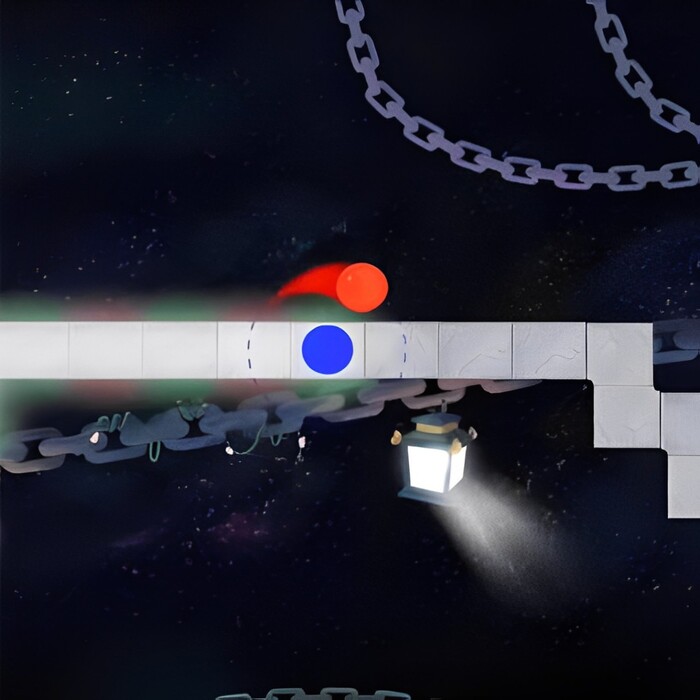
This rhythm game requires players to control two interconnected celestial bodies moving through intricate course designs. The gameplay mechanics feature dual orbs functioning as planetary objects, with one orb remaining stationary on predetermined tracks while the second orb continuously orbits around the first. Players must maintain perfect timing synchronization with the background musical compositions to progress through each challenging level. Success depends entirely on pressing control inputs at precisely the correct moments, matching the rhythmic patterns of the accompanying soundtrack.
Core Game Features
The exceptional audio design stands as the game’s most distinctive characteristic, requiring maximum volume settings for optimal gameplay experience. This is essential because audio cues provide the primary guidance system for successful navigation through each challenging section.
Players explore extensively diverse fantasy environments, each featuring unique visual themes that correspond with different musical genres and styles. Try to appreciate how each world presents distinct atmospheric elements that enhance the overall rhythmic gaming experience.
Musical notation complexity increases progressively throughout the game, with triangular symbols representing triplet note patterns and angled vertical markers indicating swung rhythmic elements. Must understand that traditional directional indicators are absent, replaced instead by innovative pattern designs that challenge conventional rhythm game expectations.
Each gaming world includes speed trial challenges and exceptionally fast bonus levels designed specifically for experienced players seeking additional difficulty. Could attempt these advanced sections only after mastering the fundamental rhythm mechanics in standard gameplay modes.
Related Gaming Options
Players seeking similar rhythm-based challenges can explore various other musical gaming experiences that emphasize timing precision and audio synchronization skills. The rhythm gaming genre offers numerous alternatives featuring comparable mechanics and musical integration systems.